

Twenty Twenty-Three is the WordPress team's default theme built around the full site editor, released as a stripped-down base rather than a finished design. It's free, it's everywhere by default on new installs, and our analysis of live sites shows it still ranks as one of the fifty most used themes we track — though its share has been drifting down as newer default themes take its place.
A blank canvas, on purpose
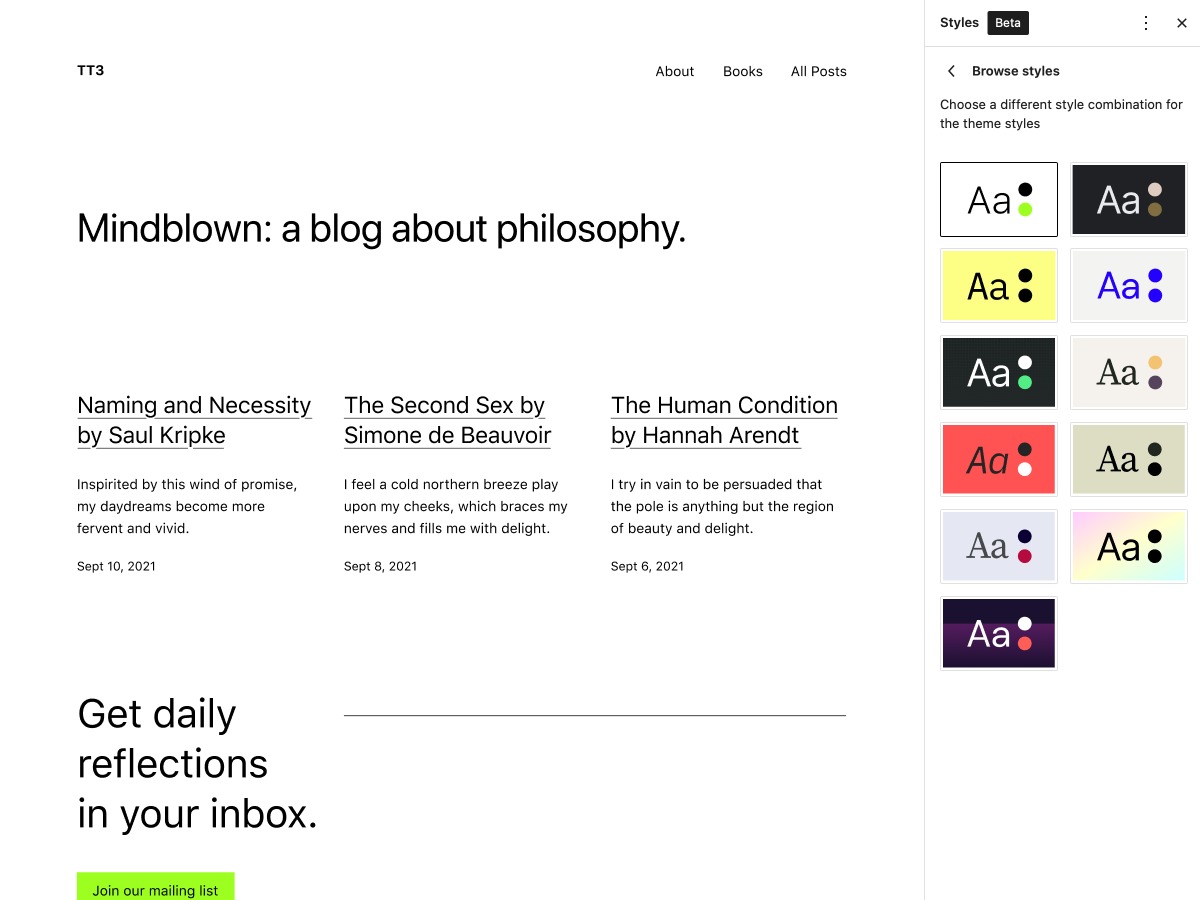
Unlike most themes on this site, Twenty Twenty-Three wasn't designed to look like anything specific. The WordPress team shipped it with almost no built-in styling, then bundled ten separate style variations contributed by the community — swap one in and the whole look changes, fonts, colors, spacing included. The author describes it as a way to build "a complex or incredibly simple website" from the same starting point, and that's fair: it's less a theme than a template for building your own.
Who actually ends up running it
The sites we see running it lean toward personal blogs, photography and portfolio sites, and community or education pages — the kind of project where one person controls the whole build and just wants a clean, free base to start from. It's not a niche theme by any strict measure; agencies, nonprofits and small services show up too. But the pattern points to solo builders and hobbyists more than agencies churning out client sites, which tracks with the personal and services business types that dominate the data.
No builder plugin required — that's the whole point
Twenty Twenty-Three runs entirely on core WordPress block editing, with no dependency on a separate page-builder plugin. That's visible in the plugin data: Yoast SEO, Contact Form 7 and Site Kit show up constantly alongside it, which is what you'd expect on sites built with native blocks and a few essential utilities rather than a heavy design stack. Elementor does appear on a meaningful chunk of installs, though, which tells you plenty of owners still bolt on a builder rather than trust blocks alone for layout.
What it gets right, and where it thins out
The strength here is honesty: no bloat, no upsell nags, fast to load because there's barely anything to load. For a writer, photographer or small organization that just needs a page up quickly with the free style variations, that's genuinely enough. The weakness is the flip side of the same coin — it has almost no child themes built around it, which means customization mostly happens by hand in the site editor rather than by picking a polished pre-made variant. If you want e-commerce depth or a designed-out homepage on day one, you'll be building that yourself, and WooCommerce shows up on only a small slice of these installs for a reason.
What else is worth a look
If you want the same no-frills approach but newer, Twenty Twenty-Five and Twenty Twenty-Four are the direct successors and where new default installs land now. For a magazine or news layout with more design out of the box, Newspaper is the paid alternative most people compare against. And if you're curious how far back this family goes, Twenty Fourteen is the older, pre-block-editor version of the same idea.
Before you decide
Is Twenty Twenty-Three free?
Yes, it's a free default theme from the WordPress team, available in the official theme directory with no paid version.
Does it need a page builder like Elementor?
No — it's built for the native full site editor and works fine without one. Some owners add Elementor anyway for more layout control, which shows up regularly in our plugin data, but it isn't required.
Is it good for an online store?
Not really its strength. WooCommerce appears on only a small share of the sites running it, and there's little built-in e-commerce styling — a dedicated store theme will save you time.
Who this is really for
Pick Twenty Twenty-Three if you want a genuinely free, lightweight base for a blog, portfolio or small community site and you're comfortable shaping it yourself in the site editor rather than picking a finished design. Skip it if you want a store, a heavily designed homepage, or a theme with a library of ready-made child themes to choose from — the successor themes in this family, or a purpose-built alternative, will get you there faster.
Last updated 2026-11-04